
Studio Note 7 – August 2026
A note on origin, reproduction and the history carried by the things from which everything else begins.
I began this Studio Note series with a question: Why are we craving originality again? It is becoming something of a preoccupation.
Not because I believe everything must be entirely new. The more I think about creativity, the less convinced I am that anything begins in isolation. Every artist carries influences. Every writer inherits language. Every idea emerges from other ideas, experiences and encounters.
Yet the word original continues to carry weight.
Recently, I read a piece on LinkedIn about rare physical books being destroyed after their contents had been captured for use in building the future. I found the thought deeply uncomfortable. If the words had been preserved, what exactly had been lost? Why should the survival of the object matter?
That discomfort released a cascade of questions.
Why do originals matter?
To what extent should they matter?
And can everything they contain ever truly be reproduced?
Is an original more than a container?
A book carries words. A painting carries an image. A recording carries sound. If those contents can be copied with complete accuracy, it is tempting to think the original has served its purpose. The information remains. The image survives. The sound can still be heard.
But perhaps an original is not merely a container for its contents.
A rare book has existed in the world. It has passed through hands, rooms, institutions and time. Its paper has aged. Its edges may have softened. It may carry annotations, damage, repairs or the almost invisible evidence of previous lives.
As I explored in What Makes Something Feel Personal?, objects can become containers for meaning. Not only through what they were made to hold, but through everything that happens to them afterwards. The same is true of an original artwork.
It contains the image, certainly. But it also contains the event of its making.
The pressure of the hand. The resistance of the material. The decisions that remained and those that disappeared beneath later marks. The particular person the artist was on the day it came into being.
A reproduction may carry the image. The original carries the event of its making.
What does the original know?
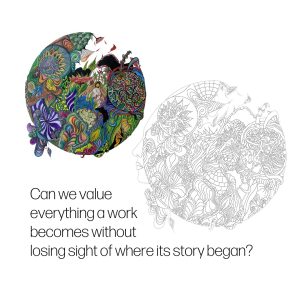
The cover image for this Studio Note shows two versions of the same work.
The first is an original drawing and painting I made during Covid. It was my first real foray into colour, which until then had terrified me. The image matters to me, but so does the moment it records: a point in my life and practice when I crossed a threshold I had been reluctant to approach.
The second version was created recently with Adobe Illustrator’s Concept to Vector feature. I gave the tool my original and set it to preserve the artwork as closely as possible while translating it into vector form. My intention was not to reimagine the work, but to reproduce it in another medium.
For all practical purposes, it is a recreation. It retains the energy and structure of the drawing, although its surface has changed. It is cleaner. Paler. Made from infinitely scalable lines rather than the physical marks I placed on paper.
And then something unexpected happened.
Illustrator added a face.
A large profile appeared along the outer edge of the vector image. It was not a face I had consciously drawn. It should not, strictly speaking, have been there.
But I loved it.
People have told me for years that they see faces, figures, symbols and other emerging forms within my abstract work. None of them are deliberately placed. The work seems to leave enough ambiguity for different eyes to complete it differently.
Now a machine had done something curiously similar.
In Why do old drawings sometimes become new ideas?, I wondered whether a piece of work can contain things the artist has not yet recognised. Here, the question became stranger. Had the technology added something foreign to the work – or made one possible reading of it visible?
Does the derivative diminish the original?
I don’t think it does.
The vector version has value of its own. It showed me something. It changed my relationship with the image. It may even become the beginning of another piece of work.
But it has a different history. A different story.
It cannot become the drawing I made during Covid. It cannot acquire the fear I felt about using colour, or the significance of discovering that colour had a place in my practice. Those things belong to the original – not because the original is automatically better, but because it is irreplaceably located at the beginning.
This connects with another question I asked in When does an image stop belonging to its creator?: does reinterpretation weaken an original, or help it travel beyond the circumstances in which it first appeared?
We see familiar images reworked across generations. Their meanings change. New artists leave fingerprints upon them. Yet the existence of those later versions rarely makes the original less significant. Often, it sends us back to it.
Perhaps a derivative does not take value away from its source.
Perhaps it reveals how much possibility the source contained.
If the tool changes the work, is it still mine?
This is the more uncomfortable question for many of us.
AI did not create my original drawing. I chose to offer it to an Adobe tool. The tool produced a variation I could not have predicted. I then recognised something within that variation and chose to keep it.
So where does authorship sit?
In the first mark?
In the unexpected contribution?
In the recognition that the contribution matters?
Or in the judgement that decides what happens next?
In Why Does Digital Perfection Feel Empty?, I argued that the involvement of a digital tool does not automatically erase authorship.
The more important question may be whether we can still feel a human presence in the choices.
That feels particularly relevant here.
The vector image did not emerge from an empty prompt. It came from a physical work, a visual language and a history that already existed. The tool introduced an interpretation. I contributed the source, the selection, my response to it and whatever I choose to do with it now.
The vector was born from my original. The face was not something I asked for, nor something I had consciously placed there. But I recognised something in what emerged and chose to keep it.
Perhaps that is where the process became collaborative.
Not collaboration in the human sense. The machine has no personal investment in the outcome. But something occurred between my work and a system built from accumulated patterns of human making and recognition. The result surprised me.
Should I reject it because I did not think of it?
Human creativity has never worked that way.
We develop thoughts through conversation. We borrow methods. We respond to accident. We notice what materials do. We accept suggestions, resist them, alter them and make choices because of them. The fact that an idea did not arrive entirely from within us does not make our response to it meaningless.
So why do originals matter?
Perhaps they matter because they hold origin.
Not purity. Not superiority. Not proof that everything which follows is lesser. Origin.
The original is the place where a particular history begins. It carries the first encounter between an impulse and a material, between intention and uncertainty, between the person who began and the work that appeared.
What follows may become beautiful, useful, meaningful or original in its own right.
It may reveal something the first work kept hidden. It may travel further. It may speak more clearly to another time.
But it does not make the beginning irrelevant.
Perhaps the value of an original is not diminished by what comes after it. Perhaps everything that grows from it makes its existence matter more.
The original does not have to remain untouched in order to retain its significance. It can be copied, translated, digitised, reworked, misunderstood and rediscovered. New versions can enter the world without making the original replaceable.
Because what makes it original is not simply that it came first.
It is that this particular object, image or act of making occupies a place in history that no later version can inherit.
A continuing conversation…
Every Studio Note begins with a question rather than an answer.
This one began with rare books, moved through an old drawing, acquired a face I had never intended, and somehow returned me to the question that began the entire series. Why are we craving originality again
Perhaps because, in a world increasingly able to reproduce the contents of almost anything, we are becoming more conscious of what cannot be copied quite so easily.
History.
Presence.
Relationship.
The trace of an encounter.
The knowledge that something happened here.
Over the coming weeks, I’ll continue following the questions this Note has opened across social media – as the conversation moves through meaning, authorship, interpretation and the unexpected places creative work can take us.
But for a now, question to leave you with…
If a reproduction preserved everything you could see, read or hear in an original, would anything still be missing?
And if so, what do you think that missing thing is?